Portfolio Introduction
Firstly—thank you, to my client who has allowed me to post a part of the work I’ve done on my public portfolio. In the process, I have gained invaluable skills related to business and data analysis, and better integrated my workflow for this type of information.
The main focus of this project was to sort existing data and information scattered around the internet, to analyze, and to condense it into an executive-readable format.
My goal was to provide an overview of the business, along with an analysis of the business in regards to brand strategy, including the role of the company in the business ecosystem at large, and to also provide a personal evaluation of the business trend and forecasted growth. In addition, due to client-specific needs, I researched new ideas for fundraising and growth—especially as related to the chosen business and similar third-parties surrounding it.
The overall purpose for this project was to present information in condensed yet meaningful ways, and to:
- Perform a business and data analysis and understand their role in the business ecosystem
- Identify the effects of third-parties on the chosen business and the business on third-parties
- Explain the interaction between the business and its consumers in the context of a dynamic business ecosystem
Overview
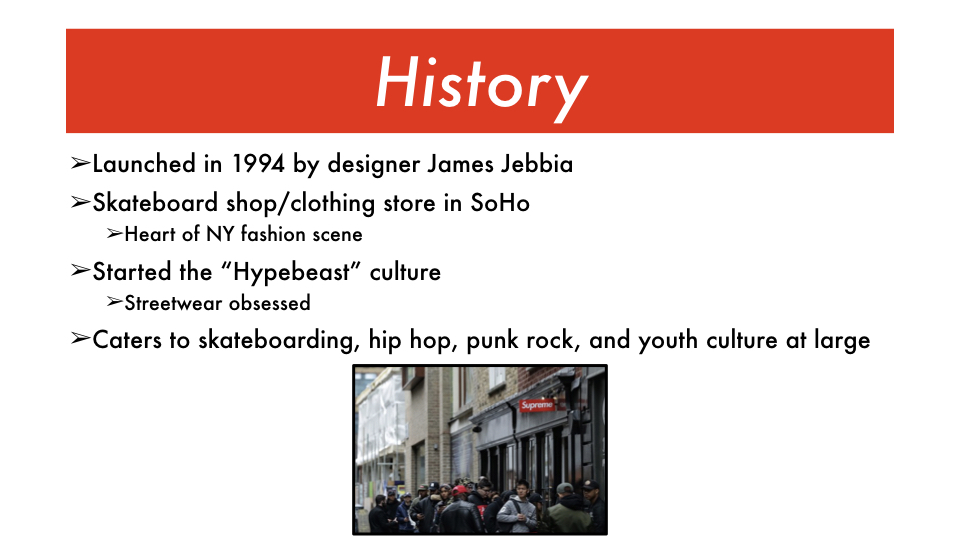
- Supreme was founded by upcoming-designer James Jebbia in 1994
- Jebbia opened the first Supreme store in an old office building on Lafayette Street
- Located in SoHo, the heart of the New York fashion scene, Supreme thrived in the area
- Originally started as a skateboard shop and then grew into retail through its strong reputation in the community
- Their customers are loyal to the point of even starting a culture of people who are obsessed with this type of streetwear, they are dubbed “Hypebeasts”
- This movement/global trend of “hypebeast” broadened the market
- Increased overall interest and prestige of their products
- Customers are known to stand in lines spanning multiple blocks on their NY streets
- That’s an expected 3 hour wait (at least)
- Their customer loyalty will also be evident later with large investments from interested investors
- This movement/global trend of “hypebeast” broadened the market
- They now cater to the skateboarding, hip hop, punk rock, and youth culture at large
- This is a huge market
- After just 25 years of being established, Supreme has not only become a renowned name in the huge market of streetwear but has also fathered a new culture
- Supreme has dominated this market and has much more potential to achieve even greater heights
Brand Strategy
- Essentially – at its core – Supreme could be considered an advertising or content marketing company, with additional ties to direct-sales
- The company’s business strategy includes the creation and use of original content as a tool to market their clothing brand, from which they create revenue
- In practice – due to its broad, worldwide audience – Supreme is able to increase brand equity by creating high-quality media content and releasing it for free
- In doing so, they provide one product that is free, in the hopes that their audience will like it enough to desire their paid product – clothes.
- In essence, paid customers subsidize their free content
- There is additional room for growth into other market sectors due to their high brand equity and consumer trust
- The presence of global markets create an opportunity for increased revenue from the same investment, so Supreme ideally should release similar content for all audiences in different countries
- In doing so, they provide one product that is free, in the hopes that their audience will like it enough to desire their paid product – clothes.
- In practice – due to its broad, worldwide audience – Supreme is able to increase brand equity by creating high-quality media content and releasing it for free
- The company’s business strategy includes the creation and use of original content as a tool to market their clothing brand, from which they create revenue
Business Ecosystem
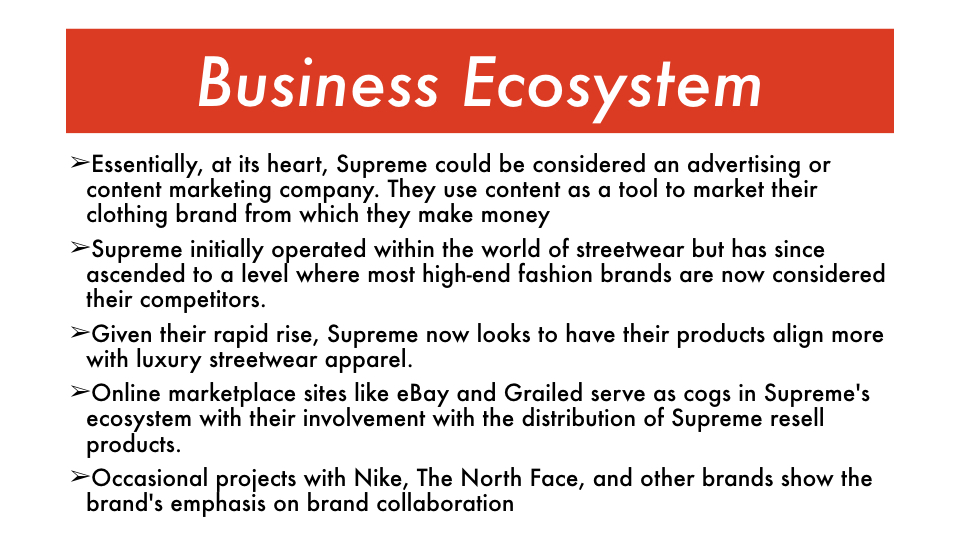
- Supreme is a fantastic example of the power in branding and scarcity economics
- Artificial scarcity is utilized by the company*⁰*
- By releasing products in sporadic quantities — the company is able to form an intense and competitive ecosystem around their product
- This incentive, based on FOMO, drives consumer willingness to pay, even at much higher prices than competing clothing brands
- By releasing products in sporadic quantities — the company is able to form an intense and competitive ecosystem around their product
- Artificial scarcity is utilized by the company*⁰*
SWOT Analysis
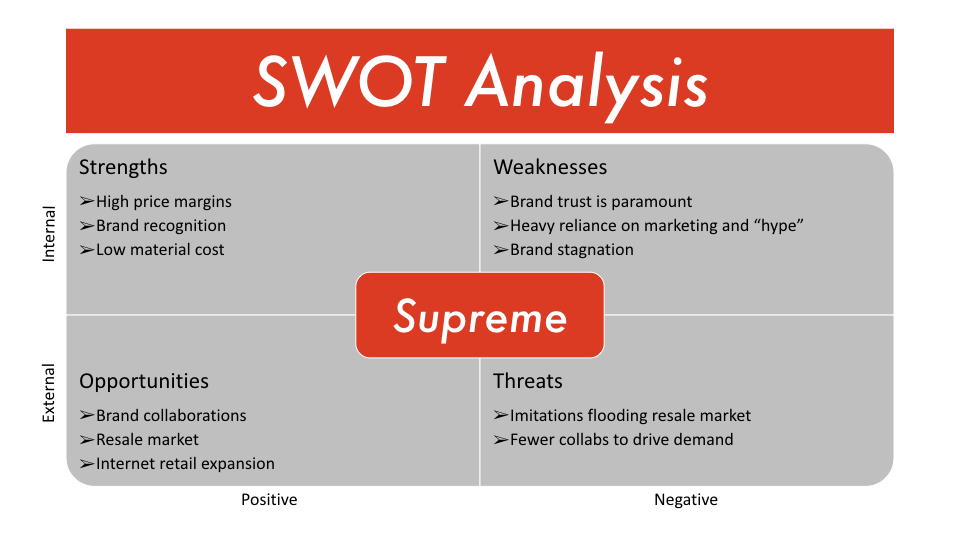
- Strengths:
- High price margins, brand recognition: Supreme’s brand notoriety stands tall among their competitors
- This allows them to deploy their marketing strategies, charging higher than usual rates for merchandise
- High price margins, brand recognition: Supreme’s brand notoriety stands tall among their competitors
- Weaknesses:
- The brand is vulnerable to becoming complacent, a criticism synonymous with the brand
- Opportunities:
- Supreme has a long track record of collaborating with its peers, a tradition that often builds excitement for the brand
- Supreme’s resale market is certainly one of a king
- It would be fascinating to see what Supreme could do, building upon their resale market with a conscious, innovative approach
- Supreme has a long track record of collaborating with its peers, a tradition that often builds excitement for the brand
- Threats:
- Supreme’s massive popularity does come a cost with their resale market being saturated with counterfeit items
Porter’s 5 Forces
- Supplier Power:
- The supplier power is high with the supplier’s long-time relationship and affiliation with the brand.
- For example, Hanes’s relationship with Supreme holds value as Hanes are responsible a chunk of Supreme’s product
- The supplier power is high with the supplier’s long-time relationship and affiliation with the brand.
- Buyer Power:
- Buyer power can shown through its influence on the resale market.
- However, Supreme would make it known if they ever responded to criticism on their product, which makes Supreme…well… Supreme
- Buyer power can shown through its influence on the resale market.
- Threat of New Entry:
- Supreme’s business model receives a lot of admiration and with that comes imitation
- It is common to see similar streetwear brands with a similar approach as Supreme
- The threat of new entrants is high, with some already in place
- Supreme’s business model receives a lot of admiration and with that comes imitation
- Threat of Substitution:
- Yes, Supreme is a streetwear clothing brand..
- However, their uniqueness earns them a spot in fashion’s upper echelon of brands
- The threat of substitution is low
- Yes, Supreme is a streetwear clothing brand..
- Competitive Rivalries:
- While Supreme does have many competitors within their industry, the brand has never publicly addressed this topic
- Much of this discussion usually comes from big admirers of the brand
- Much of this discussion usually comes from big admirers of the brand
- While Supreme does have many competitors within their industry, the brand has never publicly addressed this topic
Company Evaluation
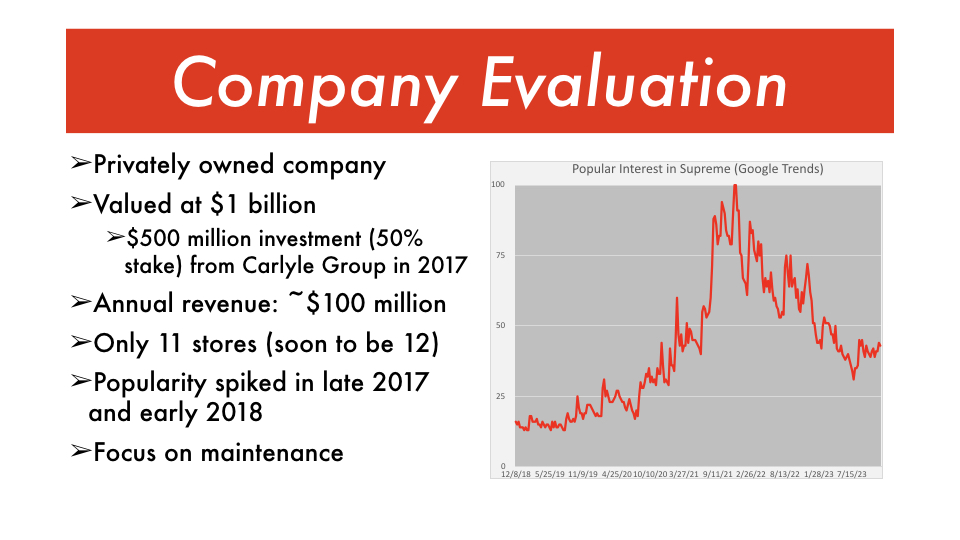
- Today, Supreme is a privately owned company, and does not offer public stock options
- Valued at $1 Billion USD*¹*; the company enjoys high annual revenues (estimated $100 Million*²*) in comparison to low original investments
- The majority of their private stock is owned by Carlyle Group, considered an angel investor who heavily invested in the company during its start-up phase*³*
- Supreme, as a perpetually growing business, relies heavily on the internet ecosystem to generate and deliver value to both customers and potential customers
- With only a dozen physical store locations worldwide*⁴*, Supreme’s direct sales are primarily made via their website
- The use of e-commerce is a rapidly growing trend among all businesses, but especially streetwear clothing companies, due to their inherent business strategy
- Resale value is generally higher than direct-sales due to scarcity
- Grailed*⁵* and eBay*⁶* are the main e-commerce platforms for sales of streetwear clothing, and Supreme
- Resale value is generally higher than direct-sales due to scarcity
- The use of e-commerce is a rapidly growing trend among all businesses, but especially streetwear clothing companies, due to their inherent business strategy
- With only a dozen physical store locations worldwide*⁴*, Supreme’s direct sales are primarily made via their website
- I believe – if Supreme continues to uphold their business strategy, and is able to sustain their high brand equity – the company will see increased revenue each year
- In the case that Supreme cannot uphold their brand/product quality, or they lose consumer trust due to failures in public relations, the company will suffer
- They must continue to differentiate themselves from other luxury clothing brand competition:
- By utilizing creative UX design as they currently do on their website, and within their various social media pages
- By retaining quality customer service and support
- By continuing to provide a convenient and exciting experience for customers who would like to purchase and view content
- They must continue to differentiate themselves from other luxury clothing brand competition:
- In the case that Supreme cannot uphold their brand/product quality, or they lose consumer trust due to failures in public relations, the company will suffer
Fundraising Opportunities
- While there is no news of an initial public offering at this time, I believe the company might be more stable as a privately owned business*⁷*
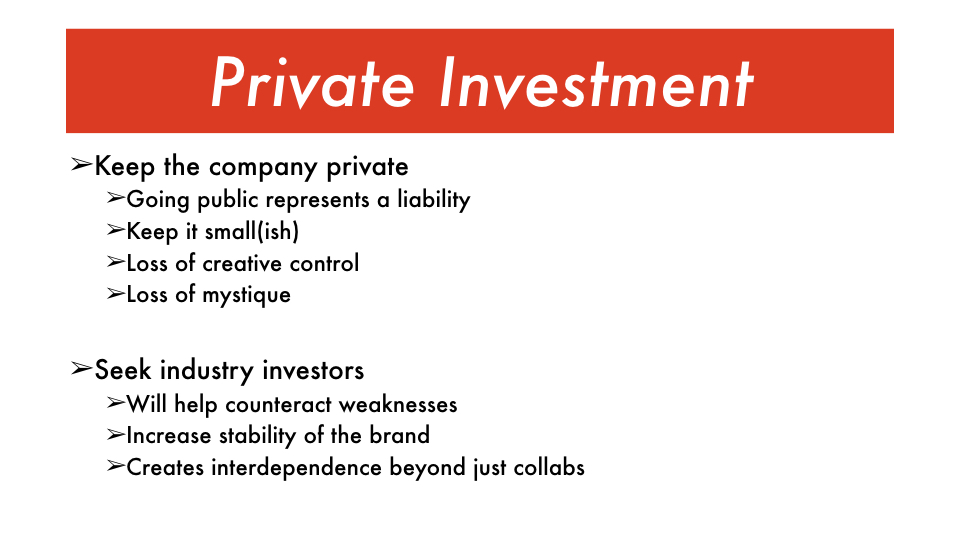
- Going public would present a liability for the company, due to potential loss
- Staying privately owned allows much more freedom in creative control
- Staying privately owned allows the company to uphold its mystique.
- As is the case with similar clothing brands, there are countless opportunities for fundraising – the following sections describe a few examples and ideas I have formulated
- Privately seeking industry investors:
- Similar to Carlyle Group and their contribution to the company in their start-up phase, Supreme can continue to seek private investors
- This would counteract any potential weaknesses from not having an IPO
- Increase the stability of the brand
- Has the potential to create interdependence beyond simple collaborations
- Similar to Carlyle Group and their contribution to the company in their start-up phase, Supreme can continue to seek private investors
- Privately seeking industry investors:
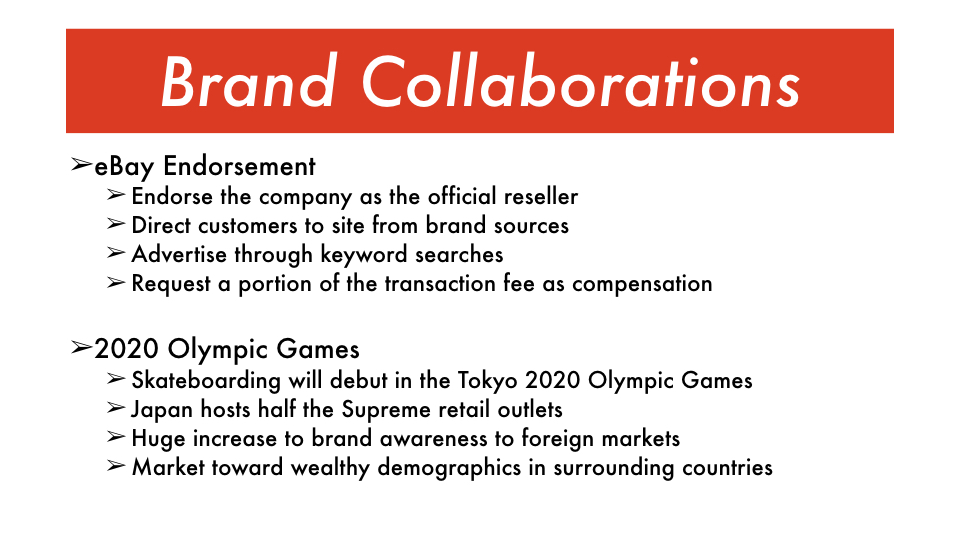
- Brand Collaborations:
- Supreme may foster growth by listing eBay as their official reseller
- This would allow a link between their official website and eBay
- This would allow advertising through the use of keyword searches
- This may be an opportunity to collect compensation from resales
- 2020 Olympic Games: [updated 03/19/2020 — It seems that the Olympics will be postponed due to CV! A loss, though Supreme might branch out in a different manner…like PR/Content]
- Skateboarding will debut in the Tokyo 2020 Olympic Games
- Japan hosts half the Supreme retail outlets, leads to direct-sales*⁴*
- Huge increase in brand awareness for foreign markets
- Market toward wealthy demographics in surrounding countries
- Supreme may foster growth by listing eBay as their official reseller
- Crowdfunding:
- The company might consider creating a donation campaign
- Create an opportunity for unprivileged youths to receive cool swag
- People who normally couldn’t afford would receive “gifts”
- Branding
- Good PR would increase brand trust and value
- Operates on the brand credibility
- Scarcity
- Limited release in line with previous collaboration
- Tax Reduction
- Donations can be written off for the company
- Inflated product cost could factor into reduction
- Create an opportunity for unprivileged youths to receive cool swag
- The company might consider creating a donation campaign