Project Summary
- Client: East Lansing Film Festival
- Budget: Confidential
- Core tasks: Branding, Promotion, Data Analysis
- Appointed date: August 2019
- Completion: December 2019
- Website: www.elff.com
Portfolio Introduction
I would like to extend my gratitude to the board for trusting me to take the reins on the promotion of the East Lansing Film Festival. Throughout this process I have learned how to apply concepts learned in the classroom to a concrete, real world client. With this, the experience they have allowed me is invaluable.
This report provides only a summary of the work and posts on the Twitter platform surrounding the promotion of the 2019 East Lansing Film Festival. This report will provide firstly an executive summary followed by an analysis of competitors, a client analysis, my proposed strategy, an overview of my results, and lastly recommendations for next year. In line with previous years, my overall goal was to increase festival attendees across all age groups in the East Lansing and surrounding areas. With the utilization of richer media type posts such as photos and videos instead of a reliance on text posts, I have aided in the increase of festival goers by receiving increased post likes, retweets, and open engagement on twitter between organizers and those involved in the production of screened films. The role of social media has enhanced the movie festival scene overall – and due to the success of this year, I believe that the popularity of the East Lansing Film Festival can only increase if its social media platforms are maintained and utilized.
Executive Summary
Equipped with Twitter as the primary platform, my main goal was to develop a strategy that would promote the upcoming East Lansing Film Festival in a clear, concise way. I wanted the strategy to fit the rapid fire nature of Twitter; one that relies on “in the moment” updates and quick information. Additionally, I realized that Twitter can offer opportunities to connect with the public beyond providing succinct information. With this, engagement with both potential festival goers as well as those involved in the films being screened were of great importance. I achieved this goal by utilizing transformational messages and richer media posts, such as posts with images, videos, and polls in order to stir excitement for the festival as well as offer the public the freedom to respond. My initial strategy was to heavy handedly use the hashtag #ELFF19 as a way to funnel information into one thread as well as stay consistent with the multiple social platforms for the festival. Due to the fact that showing movies on Halloween day posed a potential concern in terms of attendance for my client, it was more than essential that I provide sufficient updates concerning the schedule and events. My posts schedule began as a three day post operation, however, as the festival date moved closer, postings increased to multiple times daily; ensuring followers would be more than informed concerning the opening party as well as the festival itself.
As noted before, Twitter is primarily a text based, quick information social platform. With this, I found informational posts easy to execute. This is not to say that I ignored transformational messages, however. During this process, I opted to utilize transformational messages primarily proceeding the start of the festival in order to generate interest. However, as the festival approached, I utilized more informational messages in order to provide schedule updates as the movies screened throughout the day. In the end, using Twitter’s Analytics system as well as a spreadsheet of the scheduled draft tweets, I was able to identify the engagement that my posts generated through the amount of direct interactions (likes, retweets, quotes, replies) as well as impressions, engagements, and the engagement rate.
Benefits of Social Media Use
The benefits of social media are continuously growing day by day. A tool for businesses and consumers alike, social media allows for connection on a scale previously unknown, and offers priceless opportunities for communication in the information age of our modern world. For the East Lansing Film festival, social media across all platforms played an important role in generating more attendees than years prior. In this section, I will discuss the various benefits that social media can provide, as viewed through my experience with the festival this year.
- Spread of Information
-
Twitter’s posting style allows users to share information quickly – trading posts and updates in an instant. Due to this function, Twitter served an essential role in being the first line of information provided to the public/followers. If a movie time was changed – or a director was unable to attend a screening – a quick tweet could inform attendees. The additional platforms – Facebook, Instagram, and Youtube – were able to provide further information on the issues and topics that Twitter had alerted to. Social media usage allows information to be shared instantly, connecting users to like minded communities and thusly promoting events with and beyond that community.
-
- Increased Popularity & Engagement
-
Increased information sharing allows for more engagement with the brand or company. This creates more Brand Awareness and brings followers closer to the event. When working within the parameters of Twitter, I was aware that utilizing a hashtag as well as functions such as polls and quotes could aid in developing overall personality aspects of the upcoming festival itself. This was proved true as the chosen hashtag, #ELFF19 was used amongst users discussing the festival across all platforms. The hashtag allowed users to engage with the festival, developing tweets that would directly correlate to the upcoming event. Polls surprisingly became most important following the conclusion of the festival. Instead of utilizing polls to generate excitement, polls provided a helpful form of feedback in terms of what film the overall audience enjoyed.
-
- Social Media Refreshes the Old Tropes of Customer Purchase Behavior
-
Tickets for the festival ranged from ten to twenty dollars categorizing the tickets as a low purchase decision. In other words, consumers would not need an excess of information in order to purchase a ticket. Equipped with this information I realized that increasing the overall personality of the festival itself under the guise of increasing awareness for the festival, would better serve as a way to achieve overarching goals. Instead of seeking general information from the ELFF.com website, social media allows consumers to develop a complete view of the brand before making a purchase decision. With this, increasing brand personality through multiple posts ranging from heritage posts to news alerts would increase familiarity and subsequently the number of attendees would increase.
-
- Increased Personalized Adjustments To Your Brand/Event
-
An important affordance of social media is its ability to gather feedback and provide an intimate customer service experience. This notion proved true during the festival. Whether there were issues with show times, questions about ticket availability, or general inquiries for more information, the various platforms allow great flexibility in response. Through replies, direct messages, or quotes, social media allows businesses and brands to identify issues concerning the audience’s ease of attending the event and engage directly with the audience to address any issues. This affordance can play hand in hand with social media’s ability to provide direct feedback from customer to brand as well.
-
- Social Media Funnels Information Into One Location
-
Twitter’s foundation is largely built on the heavy use of hashtags used within posts. These hashtags help funnel information into one thread. This allows consumers and attendees the convenience of locating specific information concerning the festival beyond a simple Google search or information found on ELFF.com. Utilizing the hashtag, #ELFF19, updates concerning film times, reviews of films, and all additional information was able to be found in one primary location across every platform. Social Media hashtags help sort through information, creating a community and thusly creating engagement with the brand.
-
Competitor Analysis
I completed a coding scheme with comparisons for three competing film festivals — the Traverse City Film Festival, Adrian International Film Festival, and the Ann Arbor Film Festival. Through analysis of these competitors, I was able to implement a planned approach to increase engagement, and solidify the strategy for promoting on Twitter.
- Traverse City Film Festival
-
-
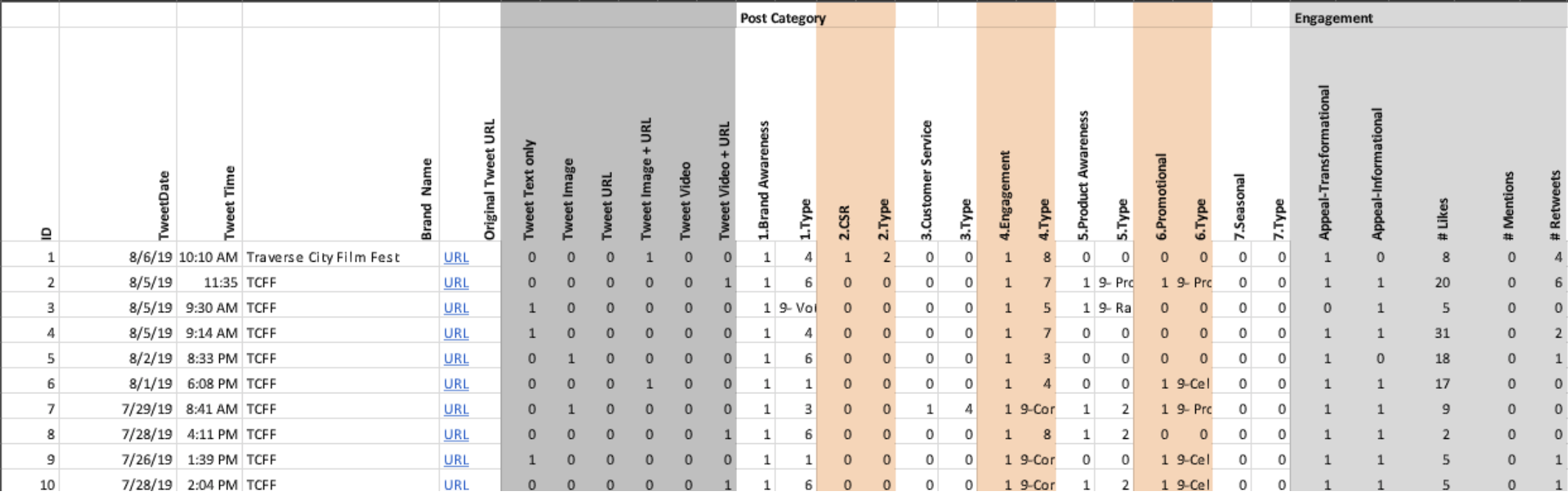
The Traverse City Film Festival located in Traverse City, MI, was founded in 2005 and is a non-profit organization. Since its establishment by Michael Moore, the festival has gained popularity amongst residents of the city and beyond. According to my coding scheme, from July 28th to August 6th, 2019, the festival acquired:
Number of Likes: 120
Av. Number of likes: 12
Number of Replies/Retweets: 15
Av. Number of Replies/Retweets: 2
-
Their tweets faired equally between informational and transformational messages, using promotional tweets the most. The posts lacked in images and videos however and mostly centered on text posts/updates.
-
- Adrian International Film Festival
-
The Adrian International Film Festival located in Adrian, MI, was founded recently in 2018. The festival has generated an impressive amount of buzz and followers considering its youth. It is a non for profit organization spanning two days long. According to my coding scheme ranging from April 17th to October 25th, 2019, the festival acquired:
Number of Likes: 53
Av. Number of likes: 5
Number of Replies/Retweets: 27
Av. Number of Replies/Retweets: 3
-
Their tweets were largely umbrellaed under Brand Awareness, Engagement, and Promotional tweets the most, the Adrian Film Festival, too, did not harbor on rich media type posts and instead utilized text exclusive posts as well. Informational posts take up the bulk of the brands’ posting strategy.
-

- Ann Arbor Film Festival
-
The Ann Arbor Film Festival in Ann Arbor, MI, is a well established festival established in 1963. The festival hosts upwards of one hundred and eighty films spreading diverse countries for every movie goer. It is a six day festival screening experimental and avant garde films and has served as a staple in the Ann Arbor community and surrounding areas. Spanning from July 24th to September 9th, the festival acquired:
Number of Likes: 17
Av. Number of Likes: 2
Number of Replies/Retweets: 6
Av. Number of Replies/Retweets: 1.5 -
The festival’s tweets were largely Engagement focused using Corporate Social Responsibility tweets such tweets that support nonprofits as their focus. Again, media richness concerning posting in terms of videos and photos both related to the festival and during the festival lacked significantly.
-

Client Analysis & Expectations
Founded in 1997 in East Lansing MI, the East Lansing Film Festival has been around for roughly 22 years. Though a concrete symbol in the community, the festival – being held at Studio C! in Okemos – frequently experiences a lower attendance rate from younger generations, namely the student community in East Lansing. With this, my client’s ultimate goal was to increase awareness amongst the student community of East Lansing and consequently the attendance of the festival overall. Flyers as well as features in the local news print publication allowed me to achieve these specific expectations of the client.
Additionally, beyond general attendance for the festival, my client wished to increase the diversity of attendees amongst ethnic origin; specifically for one film centering on issues with the Indigenous community. To achieve this goal, I attempted to contact the groups on the Michigan State Campus centering on Indigenous groups as well as faculty/instructors learned in Indigenous Study.
My final client expectations lay within the need for more attendees at the opening party. As aforementioned, the Halloween holiday served as an attendance concern for the client. With this, I was met with the challenge of clearly communicating schedules and appropriate dates and location(s) for the opening party. I achieved this goal by not only sending alerts via the twitter page, but also tagging the overarching public service group responsible for the opening film’s subject matter.
Previous Engagement
Previous posts and engagement fall in line with the competitors in my benchmarking evaluation. Posts centered largely on informational messages compared to transformational appeals. Additionally, tweets are framed under Brand Awareness with Engagement and Customer Service falling to a close second. In comparison to my chosen competition, the festival needed improvement in posts concerning promotional content, film awareness, and overall engagement. This is something I worked to improve. Consequently, I formulated a post schedule enhanced with an increased number of transformational messages, with the goal of increasing overarching engagement of the brand and an increased number of attendees.
Proposed Strategy
Purpose
This project served the primary purpose of bolstering the East Lansing Film Festival’s public profile among users on the Twitter platform. Along with focusing on brand building and recognition, I utilized Twitter as a means to convey general festival information such as schedules, announcements, and news relating to the festival; I also used the platform as a way to engage directly with the audience through replies and retweets.
Goals & Objectives
The three primary goals of publishing content on Twitter were to:
1. Meet client expectations and target the primary audiences desired.
2. Utilize a platform that is geared for quick near-live coverage and provide information to patrons.
3. Engage with the many films, directors, actors, and other cast and crew related to the films shown at the festival.
To achieve these goals, I focused on informational tweets that featured content which stands out on the average user’s feed. These tweets often featured photo grids, links to the East Lansing Film Festival website and other Social media platforms, as well as videos to increase media richness.
Strategy
My strategy had a heavy focus on conveying festival information with a transformational twist. Often when information such as film showtimes was conveyed, it would be partnered with a bright image or gif and the text would read with more personality than strict listed information. I began the project by posting approximately three times a week, then increasing in frequency as the festival neared. This schedule of posting assisted in creating the idea of a single person rather than a company behind the tweets, hoping to increase engagement on a more personable level. The increased frequency during the festival creates a bit of a live action buzz that drums up excitement about the festival, and therefore the brand.
Communication
Efficient and effective communication is key to any project, and particularly key to any social media campaign promoting a timed event. Effective communication here, is not only working with the client to be knowledgeable about the event we’re promoting, but coordinating with other people, primarily the board and directors to avoid content duplication and maintain timely relevant postings.
I primarily communicated with the client through a private e-mail thread to stay on top of weekly assignments, postings, as well as to share ideas for content and strategy. My primary alternative points of contact with the client was through our scheduled meetings on Thursdays and via phone calls.
Deployment of Social Media
Posting Plan
Though a large part of the posting plan was pre-determined by the requirements of the client (referring specifically to the day schedule set), I still retained full freedom over timing and content. As Twitter is best geared towards live, breaking, and ongoing content, I focused my efforts in supplying followers with actionable information as well as to drum up buzz about the specific events of the festival. The daily timing of the posts was not exclusively driven by my competitor analysis, in addition to that information I took into account the times of day that any given individual would a) be most likely to check their twitter feed and b) the information I delivered would be most relevant leading to a greater likelihood of the consumer taking action. With this in mind I focused on lunch breaks and mid-afternoon (just before people left work) to focus on content that had to do with festival specific events, such as the day’s schedule of show times. When the content was more generally focused on building brand image or to deal with a current on-going part of the festival I pushed towards early evening postings.
Content Examples
On Twitter, there are three distinct metrics that are key to understanding to effectiveness of the content posted. The first is the number of impressions, this shows the number of times that a tweet was loaded to a timeline. The impressions metric serves to show the number of individuals who have possibly seen your tweet.
Impressions on Twitter do not necessarily mean that someone has seen your tweet, the metric simply represents the number of times that a tweet has been served up and loaded to someone’s timeline.
The second is engagements, this shows the number of times that a tweet was interacted to which includes but is not limited to: liking, retweeting, replying, expanding the tweet, clicking the profile link, or viewing media. The third metric is the engagement rate, this is the result of a simple equation (number of engagements divided by the number of impressions) showing the rate at which users interacted with the content. On Twitter, the engagement rate of a tweet can be a good general indicator of the effectiveness of the content.
There are multiple ways to use engagement rates as an indicator of success, for my purposes I settled on the method of reaching a certain percentage goal (any engagement rate over a certain percentage). After reviewing engagement rates from the previous year’s campaign, I set a target of 1.6% or greater engagement on the tweets. This target was created by researching an average of nearly all of the previous year’s tweets engagement rates between October 1st and November 30th.
For the purposes of my target engagement rate, I excluded one specific tweet that promoted the offer of a free ticket giveaway. The rationale for this exclusion was that I was not able to provide the same or a similar offer.
Screenshot
Information
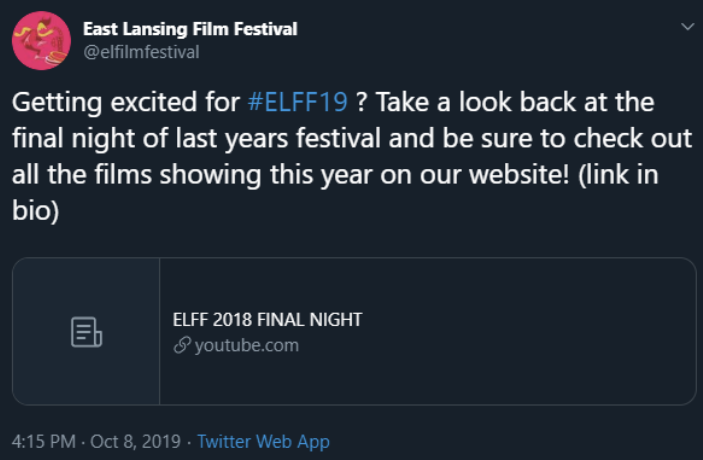
October 8, 2019 @ 4:15 PM

Informational and Transformational

Type(s) of Content:

Text, video

Strategy:

Being one of the first posts on the ELFF twitter page of the year, the goal of this was to let everyone know we are back. To do this I not only directed people to our website to see festival information, but linked to the final night recap video for a nostalgic touch.

Analysis:

3 likes, 240 impressions, 4 engagements

Engagement Rate: 1.7%
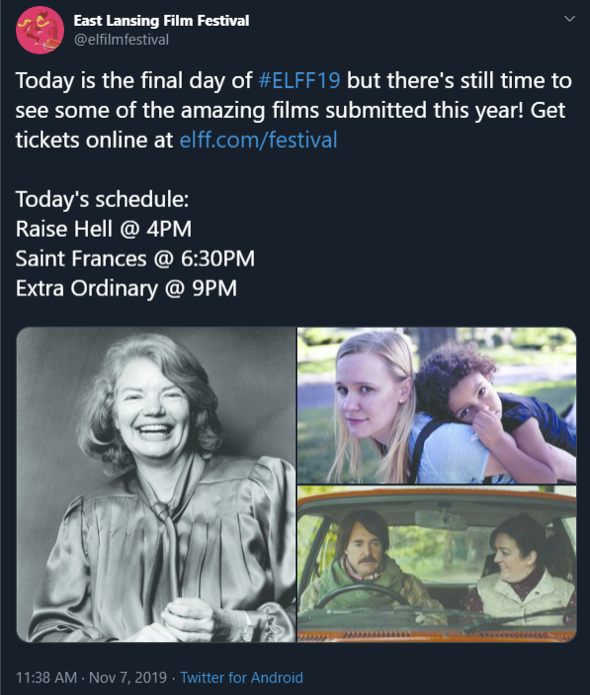
November 7, 2019 @ 11:38 AM

Informational and Transformational

Type(s) of Content:

Text, photo, url

Strategy:

Reaching the end of the festival, I added an urgent call to check for tickets and the schedule for the final films being shown.

Analysis:

5 likes, 1 retweet, 354 impressions, 17 engagements

Engagement Rate: 4.8%
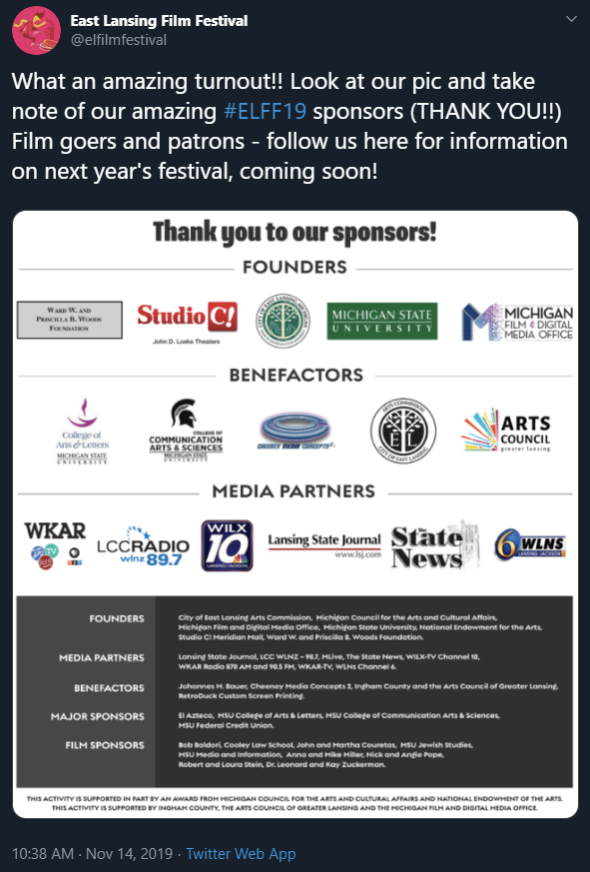
November 14, 2019 @ 10:38 AM

Informational and Transformational

Type(s) of Content:

Text, photo

Strategy:

Post festival, I began our campaign to most importantly thank those who made the festival possible, but also to remind people to stay tuned for next year.

Analysis:

3 likes, 172 impressions, 8 engagements

Engagement Rate: 4.7%
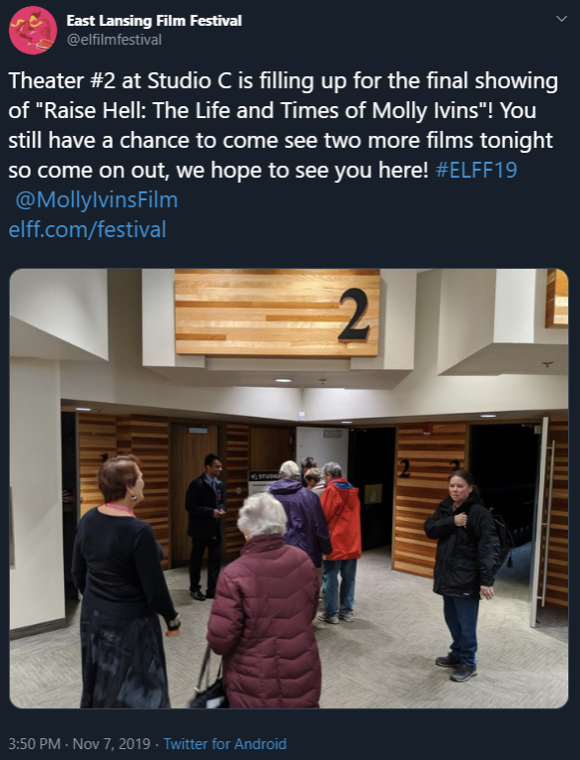
November 7, 2019 @ 3:50 PM

Informational and Transformational

Type(s) of Content:

Text, photo, url

Strategy:

Twitter excels when it comes to “live” type content, here I featured some of the action from Studio C! to encourage people to come and join in.

Analysis:

1 likes, 222 impressions, 7 engagements

Engagement Rate: 3.2%
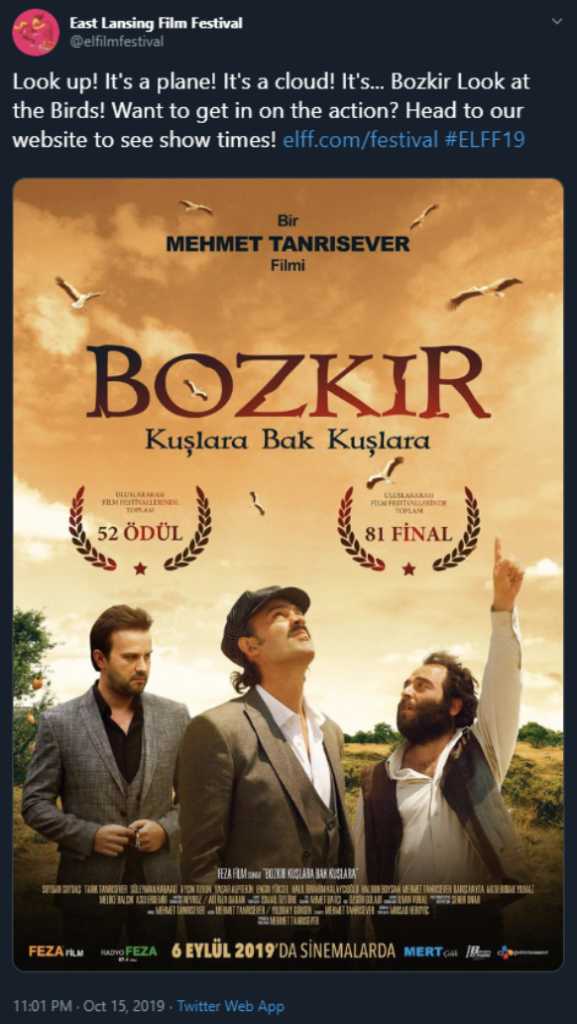
October 15, 2019 @ 11:00 PM

Informational and Transformational

Type(s) of Content:

Text, photo, url

Strategy:

With a bit of humorous word play, the goal was to draw the users attention with the large, boldly colored poster of the film and direct them to our website where they can find information on the festival and tickets.

Analysis:

2 likes, 231 impressions, 5 engagements

Engagement Rate: 2.2%
Full Post Results & Analysis
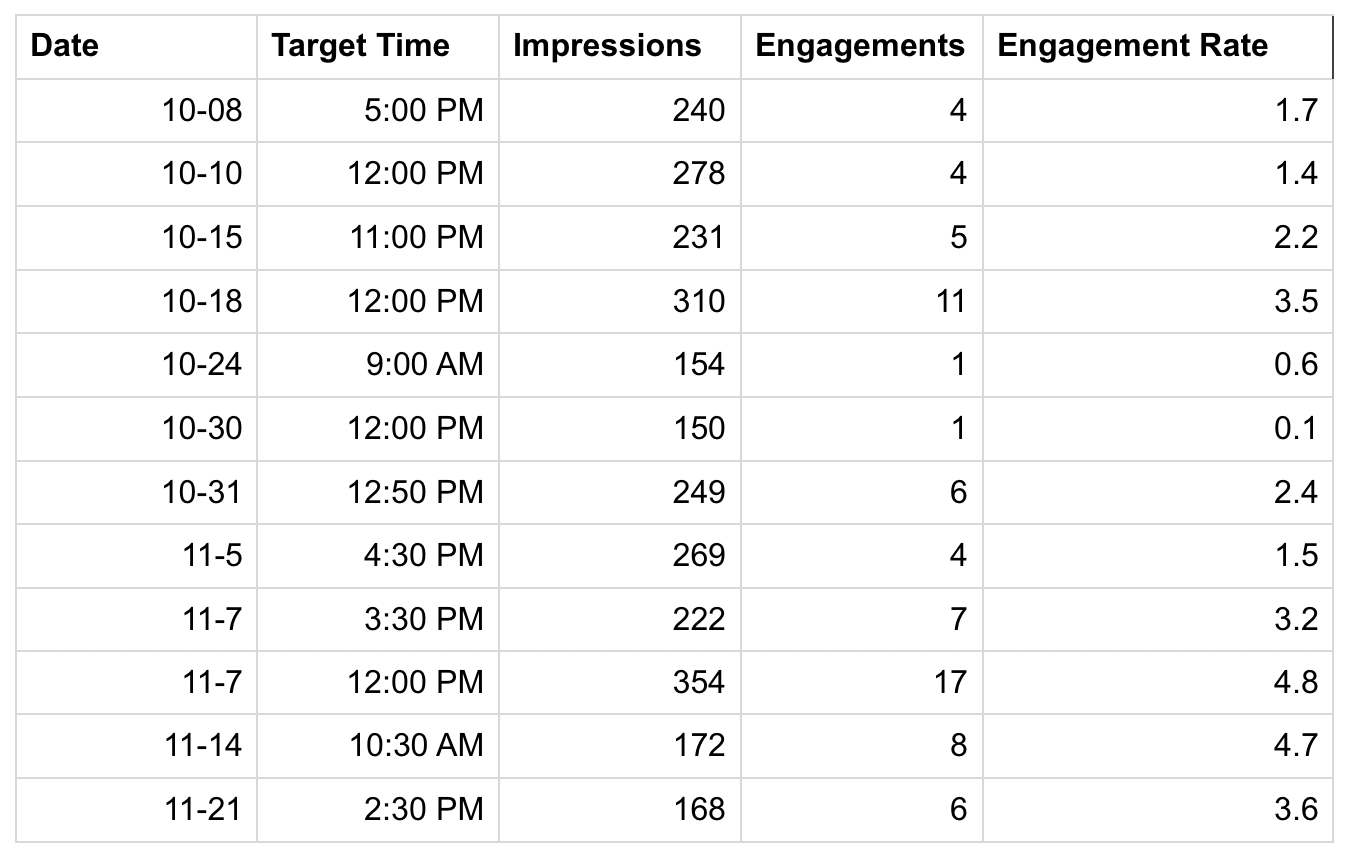
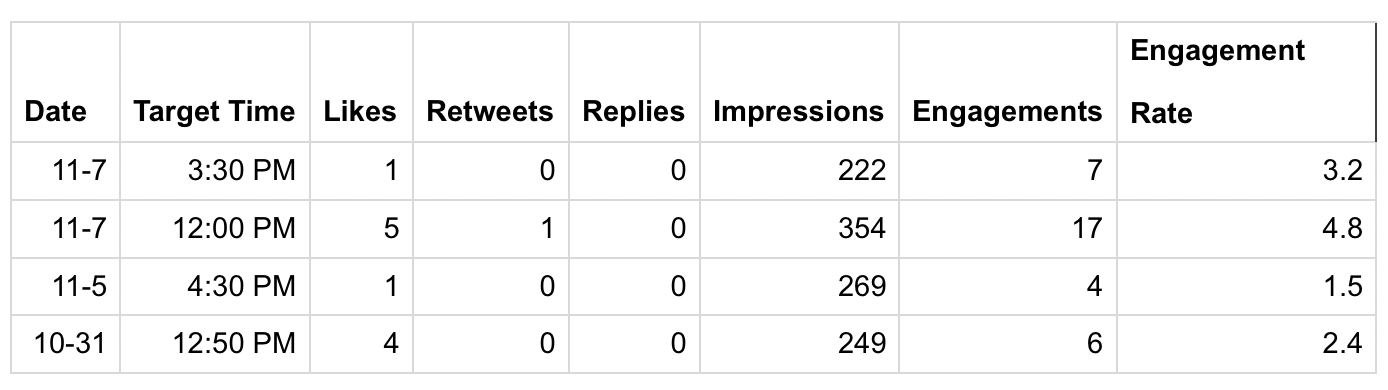
Graphs October 1 - November 30:
October Metrics
In the month of October, the ELFF twitter account saw a combined total of 28 tweets, over 7000 impressions, more than 250 profile visits, 6 mentions, and we gained 9 followers.

November Metrics
In the month of November, the ELFF twitter account had a combined total of 18 tweets, just under 7000 impressions, more than 150 profile visits, 4 mentions, and had no change in followers.
Extras
Challenges
One of the greatest challenges that I faced was finding a target audience. Twitter, as a platform, tends to have a user base that skews towards the younger generations (those in their early 20’s). Subsequently, the festival tends to skew towards slightly older generations who often do not use twitter. Since I was less likely to be able to convince a demographic to join an additional social media platform simply to follow one account, I focused on producing content that appealed to the user base already found on the platform in hopes to gain their interest in the festival.
Additional Information
I was lucky to be available during the regular film show-times and physically attend the festival. I not only helped volunteer to run the festival (handing out voting tickets and directing patrons to the theatre), but I was also able to capture live coverage of the festival and take photos that could be used for promoting the festival.
Conclusion & Recommendations
The primary difficulty in utilizing Twitter for a social media promotion campaign seems to be finding a target audience. Twitter generally skews towards the youth for their user base, and the festival tends to skew towards older generations, especially with the rise of all-online film festivals. With these inherent obstacles of running a Twitter campaign in mind, I found success in using rich text media to increase customer engagement while promoting the ELFF. A potential way to increase customer engagement might be to partner with Twitter accounts that are popular within the MSU student community. Great examples are any sponsoring colleges – or colleges with relevant connections (i.e. CommArtsSci for sponsor, Arts and Letters for general relevance, College of Engineering since the film “Walking on Water” is relevant to their fields of study). For the festival itself, there is potential to invest in adding a new section or category for MSU film students – possibly hosted on-campus – which may drive new audiences to the event.
I believe that, despite some shortcomings, this year’s promotion of the East Lansing Film Festival on the Twitter platform was a success. One of my primary goals was to reach a target engagement rate of 1.6% or greater, and I was able to achieve that goal. Though I found success in this project, I would like to conclude with a few suggestions for future social media managers, which may help boost engagement on Twitter in following years.
As noted above, one of the greatest challenges with Twitter is the gap between the target audience of festival patrons and the available audience on the platform. Since it is more difficult to convince the existing patrons of the festival to join the platform, my suggestion is to further target the existing demographics that may have interest in the festival, primarily young adults and college aged individuals.